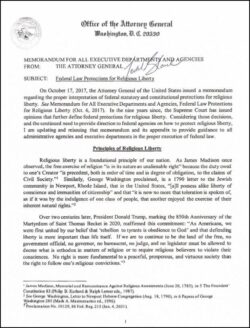
 The US Department of Justice (DOJ) has published updated guidance on federal protections for religious liberty, reaffirming the Trump administration’s commitment to safeguarding the constitutional rights of religious individuals and organizations.
[ Read the SemperVerus article, US Department of Justice Task Force Reports Steps to Eradicate Anti-Christian Bias in Government ]
The 26-page memorandum, Federal Law Protections for Religious Liberty, sent to executive branch agencies, revises and expands upon the department’s 2017 Religious Liberty Guidelines in light of significant US Supreme Court decisions issued over the past nine years.
[ Read the SemperVerus article, Religious Liberty Commission Report Addresses Violence Against Houses of Worship ]
It follows the June recommendation from the DOJ’s Religious Liberty Commission that President Trump “instruct the Department of Justice to issue guidance clarifying the proper understanding of the Establishment Clause and separation of church and state.” The Establishment Clause refers to the first phrase of the First Amendment, which prohibits the government from exerting political control over religion:
Congress shall make no law respecting an establishment of religion, or prohibiting the free exercise thereof; or abridging the freedom of speech, or of the press; or the right of the people peaceably to assemble, and to petition the Government for a redress of grievances.
[ Read the SemperVerus article, Hostility Spreading Against Religious People: Pew Research ]
“Religious liberty is one of our Nation’s founding principles and a fundamental right guaranteed by the Constitution,” says Attorney General Todd Blanche. “It is essential that federal agencies fully respect and protect the ability of all Americans to live out their faith in daily life, including in their interactions with the federal government.”
[ Read the SemperVerus article, 2025 Edition of Hostility Against Churches Report Shows 415 US Attacks in 2024 ]
 The updated guidance consisting of 21 principles directs all executive departments and agencies to ensure that federal programs, employment practices, contracting, rulemaking, and enforcement actions comply with the Constitution, the Religious Freedom Restoration Act (RFRA) of 1993, Title VII of the Civil Rights Act, and other applicable federal laws. It emphasizes that religious exercise includes not only belief and worship but also religious conduct in daily life, and that such conduct must be reasonably accommodated whenever practicable and permitted by law.
[ Read the SemperVerus article, US Federal Workers Are Now Allowed to Express Their Religious Beliefs ]
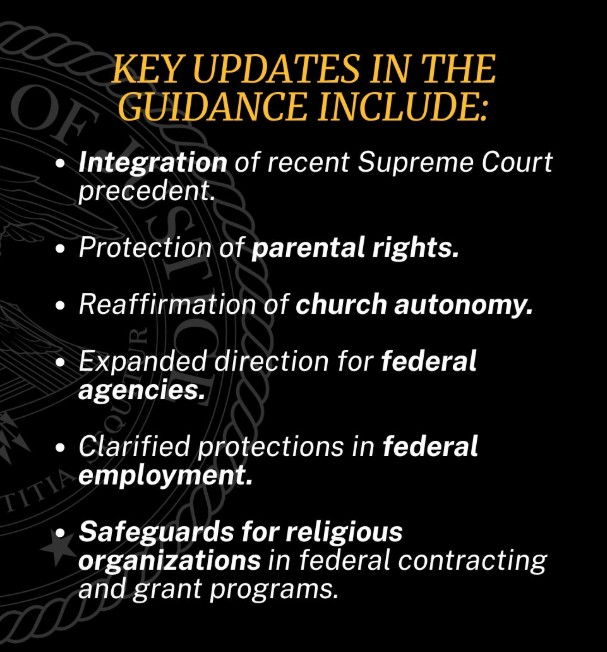
Key updates in the guidance include:
• Integration of recent Supreme Court precedent. The memo reflects recent judicial decisions (see below) clarifying the scope of the First Amendment, RFRA’s broad protection of religious liberty, and the requirement of equal treatment toward religious organizations in government programs.
• Protection of parental rights. The updated guidance emphasizes the Supreme Court’s recent precedents confirming that the Constitution protects parents’ ability to direct the religious upbringing of their children.
• Reaffirmation of church autonomy. The guidance highlights constitutional protections that bar government interference in internal religious governance, including employment.
[ Read the SemperVerus article, US Dept. of War Elevating Chaplaincy Corps Back to Spiritual Significance ]
• Expanded direction for federal agencies. Agencies are instructed to proactively consider religious‑liberty impacts when developing rules and policies, designate officers to review regulatory proposals for compliance, and ensure enforcement actions respect RFRA and other protections. Agencies must also consider religious‑liberty concerns raised by the public during notice‑and‑comment periods.
• Clarified protections in federal employment. The guidance reaffirms that agencies must follow recent Office of Legal Counsel opinions when accommodating religious expression and practice in the workplace, including scheduling accommodations and workplace religious expression.
• Safeguards for religious organizations in federal contracting and grant programs. Agencies may not condition an individual’s participation in federal programs on relinquishing their religious character or hiring rights. Religious organizations must be permitted to compete on equal footing with secular organizations.
Read the updated guidance memo HERE.
[ Read the SemperVerus article, Report: US Government “Weaponized Its Full Weight Against Christians” 2021–2024 ]
New Supreme Court decisions referenced in the memo include:
• Carson v. Makin, which ruled that a Maine tuition program could not exclude religious schools
• Kennedy v. Bremerton School District, which sided with a high school football coach disciplined for on-field prayers.
• Fulton v. City of Philadelphia, which ruled against the city’s exclusion of a Catholic foster care agency over its opposition to placing children with same-sex couples
• Masterpiece Cakeshop, Ltd v. Colorado Civil Rights Commission, which sided with a Christian baker penalized for declining to bake a cake for a same-sex wedding in 2012 when gay marriage was illegal in Colorado.
• Mahmoud v. Taylor, which sided with parents seeking to opt their children out of LGBT-related curriculum on religious grounds
• Groff v. DeJoy, which sided with a postal worker who quit his job rather than work on Sundays in violation of his faith
• Catholic Charities Bureau, Inc. v. Wisconsin Labor Review Commission, which struck down Wisconsin’s denial of tax-exempt status to a Catholic Charities affiliate over claims its work wasn’t religious enough.
• Burwell v. Hobby Lobby Stores, Inc., the 2014 ruling establishing that RFRA’s protections extend beyond individuals to organizations and at least some for-profit corporations. It points to Hobby Lobby as an example of a business protected under the law.
[ Read the SemperVerus article, The White House Launches “America Prays” Initiative ]
Invite SemperVerus® to present its 5 life-changing success-generating components—prepare, aware, be, know, do—to your organization to inspire and motivate your members.
Join the SemperVerus Brotherhood™!